Garage door motors are designed to handle daily use, but like any mechanical and electrical system, they can eventually develop problems over time. A garage door opener works hard every day, lifting and lowering heavy doors while relying on multiple moving parts, sensors and electrical components to operate safely.
If your garage door motor has stopped working, become unreliable or started making unusual noises, there is usually an underlying issue causing the failure.
Understanding the common causes of garage door motor problems can help you identify when repairs may be possible and when a full motor replacement is the better long term solution.
Common Reasons Garage Door Motors Fail
Garage door motors can fail for several different reasons, ranging from normal wear and tear through to electrical faults and installation issues.
Age and General Wear
One of the most common causes of garage door motor failure is simple age and ongoing usage.
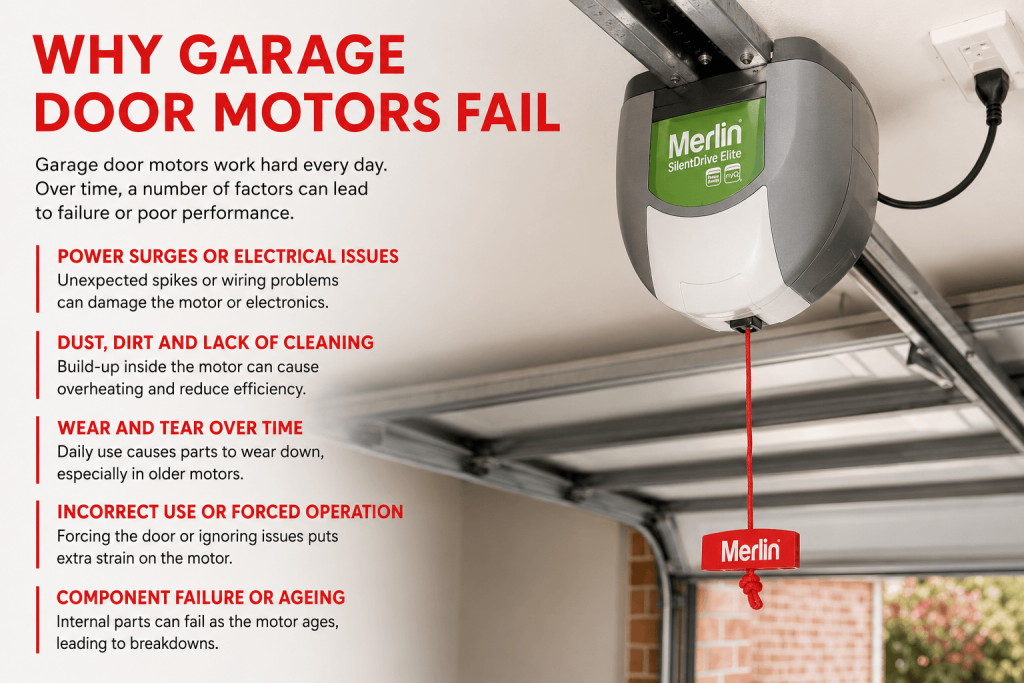
Most garage door motors open and close thousands of times over their lifespan. Over time, internal gears, drive systems and moving components naturally wear down, especially in households where the garage door is used multiple times every day.
Older systems may also become less reliable as internal electronics begin to deteriorate.
Worn Internal Gears
Garage door motors contain internal drive gears that help transfer power from the motor to the garage door system.
As these gears wear down, you may notice:
- Grinding noises
- Jerky movement
- Motor running without moving the door
- Intermittent operation
- Slipping during opening or closing
In some older garage door opener systems, replacement parts may no longer be available, making motor replacement the more practical option.
Electrical Problems
Electrical faults are another common cause of garage door opener failure.
Garage door motors rely on circuit boards, wiring and power supply components to operate correctly. Electrical problems can develop due to:
- Power surges
- Faulty wiring
- Moisture exposure
- Worn circuit boards
- Ageing electronics
In some cases the opener may stop responding completely, while other systems may operate inconsistently or trigger warning lights.
Garage Door Springs Causing Excess Strain
Many people assume the motor does all the heavy lifting, but garage door springs actually carry much of the door’s weight.
If the springs become worn, damaged or incorrectly balanced, the motor can become overloaded trying to lift a heavier than normal door.
Over time this added strain can lead to:
- Premature motor wear
- Burnt out motors
- Slower operation
- Overheating
- Gear damage
This is one reason regular garage door servicing is important for overall system longevity.
Signs Your Garage Door Motor May Be Failing
Garage door motors often show warning signs before they fail completely.
Common symptoms include:
- Garage door not opening or closing properly
- Motor running but the door not moving
- Clicking, grinding or humming noises
- Door stopping halfway
- Intermittent operation
- Flashing opener lights
- Slow response times
- Remote controls not responding consistently
- Door reversing unexpectedly
If your garage door system is showing several of these symptoms, it may be time to have the motor professionally assessed.
Can Garage Door Motors Be Repaired?
Some garage door motor issues can be repaired depending on the age of the system and the cause of the problem.
Minor issues such as remote programming, safety sensor alignment or small component failures may sometimes be resolved without replacing the entire opener.
However, replacement is often recommended when:
- The motor is older and unreliable
- Internal gears are badly worn
- Circuit boards have failed
- Replacement parts are discontinued
- Repairs are becoming frequent
- The opener no longer meets modern safety standards
In many cases, replacing the garage door motor provides a more reliable and cost effective long term solution.
Modern Garage Door Motors Offer Improved Features
Some garage door motor issues can be repaired depending on the age of the system and the cause of the problem.
Minor issues such as remote programming, safety sensor alignment or small component failures may sometimes be resolved without replacing the entire opener.
However, replacement is often recommended when:
- The motor is older and unreliable
- Internal gears are badly worn
- Circuit boards have failed
- Replacement parts are discontinued
- Repairs are becoming frequent
- The opener no longer meets modern safety standards
In many cases, replacing the garage door motor provides a more reliable and cost effective long term solution.
Professional Garage Door Motor Assessment
Because garage door systems involve both electrical components and high tension springs, professional assessment is important when diagnosing motor problems.
A qualified technician can inspect:
- Motor condition
- Spring balance
- Track alignment
- Door weight
- Safety systems
- Electrical components
- Overall opener compatibility
This helps identify whether the issue can be repaired or whether replacement is the safer and more reliable option.
Because garage door systems involve both electrical components and high tension springs, professional assessment is important when diagnosing motor problems.
A qualified technician can inspect:
- Motor condition
- Spring balance
- Track alignment
- Door weight
- Safety systems
- Electrical components
- Overall opener compatibility
This helps identify whether the issue can be repaired or whether replacement is the safer and more reliable option.
Garage Door Motor Replacement Central Coast
If your garage door motor has stopped working or is showing signs of failure, Affordable Openings provides professional garage door motor replacement services across the Central Coast.
We replace residential and commercial garage door motors using trusted systems from Merlin and Grifco and can recommend the right solution for your garage door setup.
Frequently Asked Questions
Garage door motors can fail suddenly due to electrical faults, power surges, worn internal components or excessive strain from spring problems.
Yes. Motors can burn out over time, especially if the garage door is unbalanced or the opener is under excessive strain.
Most garage door motors last around 10 to 15 years depending on usage, maintenance and environmental conditions.
This depends on the age of the system, the availability of replacement parts and the extent of the damage. Older systems are often more economical to replace.
Yes. Faulty or unbalanced springs place additional strain on the motor, which can lead to premature wear or motor failure.