Key Differences of Roller Doors vs Panel Lift Doors
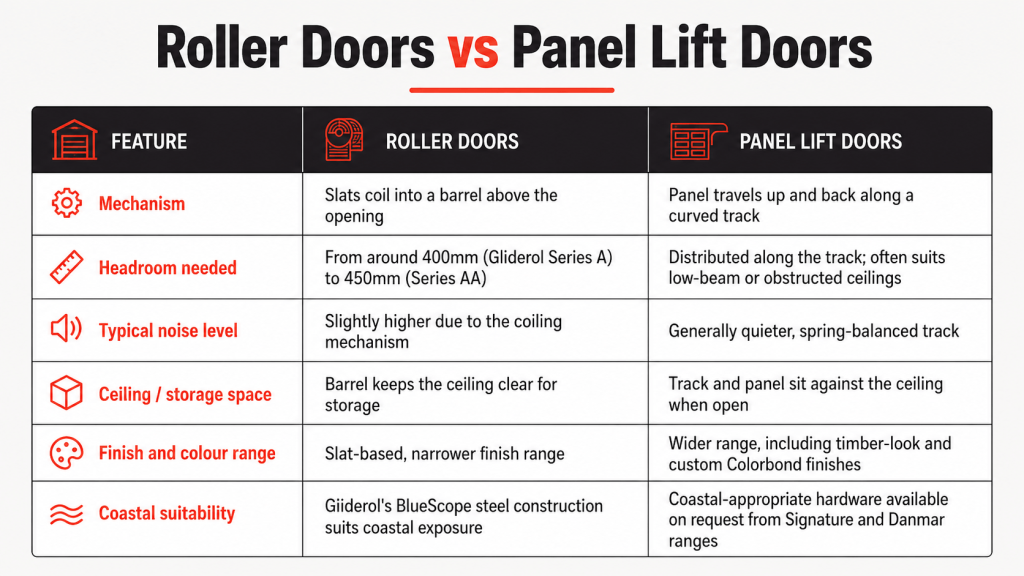
Most people come to us already having decided which type of garage door they want, usually based on what a neighbour has or what looked good on a display board somewhere. That’s a reasonable starting point, but it isn’t always the right one. A roller door coils into a compact barrel above the opening. A panel lift door, also called a sectional door, travels up and back along a curved track instead. That single mechanical difference is what decides almost everything else: how much headroom you need, how the door sounds, and how it looks once it’s finished.
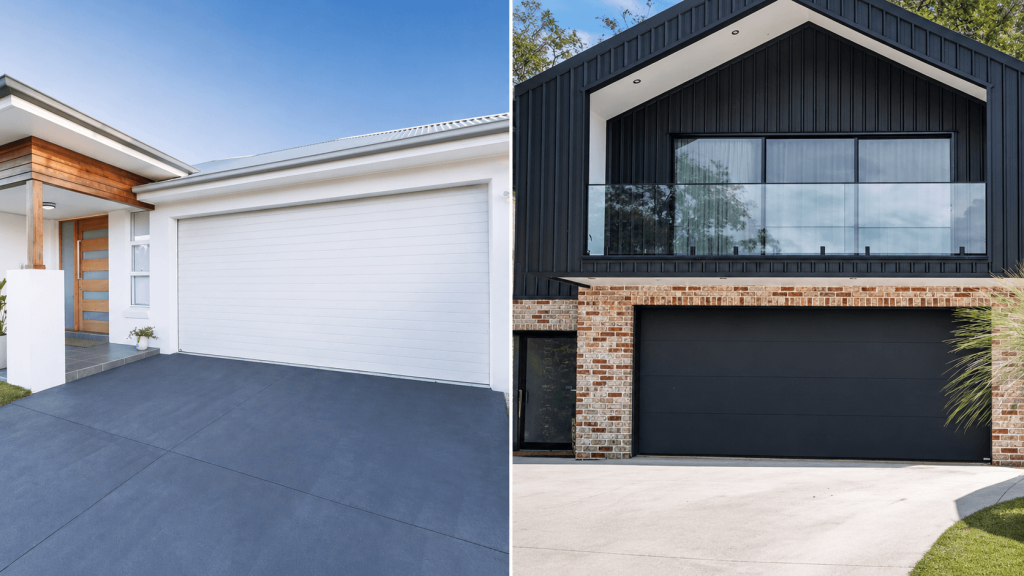
How each door actually moves
A roller door is made from interlocking horizontal slats that curl upward into a compact barrel mounted above the opening. The whole door disappears into that barrel as it opens, which is why roller doors are often the default choice where space is tight. There’s no swing, no pivot, nothing projecting into the garage itself once the door is up.
A panel lift door is built from one continuous panel, or several connected panels, that travel up and back along a curved track, ending up sitting flat against the garage ceiling. Some people call this a sectional door, some call it a panel lift, and on the Central Coast the terms get used almost interchangeably. The mechanism is the same either way: horizontal panels riding on a guided track rather than coiling into a barrel.
As the exclusive regional supplier of Gliderol roller doors, and an installer of both door types across the Central Coast & Lake Macquarie every week, we see the practical trade-offs between the two up close rather than off a spec sheet. Affordable Opening’s roller doors are built on Gliderol’s platform, manufactured from BlueScope steel specifically for Australian conditions. Our panel lift and sectional range runs through Signature, Danmar and B&D, which is where most of the timber-look and custom colour options come from. That brand split matters later in this guide, particularly for coastal durability and finish choice.
Headroom is usually the deciding factor
In our experience, headroom above the opening settles this decision more often than style preference does. A Gliderol roller door needs around 400mm of clearance above the opening for the Series A range, or 450mm for Series AA, before the barrel and motor can be housed properly. If that clearance genuinely isn’t available, a mini roller mechanism can bring the requirement down further, though the trade-off is a reduction in the usable opening height.
Panel lift doors need clearance too, but it’s distributed differently along the horizontal track rather than concentrated in a single barrel above the opening. This makes panel lift a common solution in garages where there’s a beam, a light fitting or ducting sitting close to the ceiling that a roller door’s barrel simply can’t work around.
One thing many homeowners overlook is that this isn’t just a new-build consideration. Older Central Coast homes, particularly anything built before garages were designed with automation in mind, often have less headroom than people assume until it’s actually measured. It’s worth having this checked before you commit to a style, not after the door has already been ordered.
Noise, insulation and everyday use
Panel lift doors are generally the quieter of the two. The spring-balanced track mechanism distributes load evenly across the panel, and there’s no coiling action generating the mechanical noise a roller barrel produces as the slats wind in. For a garage under a bedroom, or a home where the garage doubles as a workshop, that difference is noticeable over years of daily use, not just on the first demonstration. Roller doors aren’t loud in any objective sense, but if quiet operation is a priority, panel lift has the edge.
Roller doors make up for this in other ways. Because the moving parts are contained within the barrel rather than running the full depth of the garage ceiling, they leave the space underneath completely clear, which matters if the garage is also used for storage, a workbench, or overhead shelving.
Insulation is available across both door types now, and this is worth raising directly with whichever option you’re leaning toward rather than assuming it’s included as standard. A poorly insulated garage door is one of the more common regrets we hear about after the fact, particularly in garages that back onto a living space.
Coastal conditions change the calculation
This is where being on the Central Coast actually matters to the decision, rather than being incidental to it. Salt-laden air accelerates corrosion on any exposed metal componentry, and both roller and panel lift doors have hardware that’s exposed to varying degrees: tracks, springs, fixings and, for roller doors, the barrel mechanism itself.
Gliderol roller doors are manufactured from BlueScope steel specifically for Australian conditions, which is a genuine advantage in coastal suburbs from Terrigal through to Woy Woy. Panel lift doors from Signature and Danmar can be specified with coastal-appropriate hardware and finishes as well, but it needs to be asked for rather than assumed. Whichever door you choose, properties within a few kilometres of the coastline benefit from a more frequent maintenance rhythm than the same door would need further inland, generally a rinse-down and a visual check on hardware every few months rather than once a year.
Security, finish and street appeal
Both door types perform well on security when properly installed and maintained, but they achieve it differently. A roller door’s slatted construction and barrel mechanism make it inherently resistant to forced entry from underneath, since there’s no single panel to lever or pry. Panel lift doors rely more on the track and lock mechanism, which is why the quality of the installation and the locking hardware specified matters more with this style.
On finish, panel lift currently has the wider range. Because the surface is a single flat panel rather than overlapping slats, it can carry timber-look finishes, a broader Colorbond colour range, and the custom designs Signature and Danmar are known for, in a way that’s harder to replicate on a rolled slat surface. If street appeal and matching a specific architectural style is the priority, that’s usually where panel lift pulls ahead.
Which one actually suits your situation
Generally, if headroom is limited, or the garage is also functioning as a workshop or storage space, a roller door is the more practical fit. If quiet operation matters, particularly with a bedroom above or adjacent to the garage, or if you want a broader choice of finish to match the rest of the house, panel lift is usually the better starting point.
Neither door is objectively better than the other. They’re built for slightly different priorities, and the right choice comes down to the specifics of the opening, the way the garage gets used day to day, and how exposed the property is to coastal conditions. That’s genuinely easier to work through in person, against the actual opening, than it is from a comparison page alone.
If you’re weighing up roller against panel lift for a property anywhere between the Central Coast, Lake Macquarie and the Hunter Valley, our team can measure the opening and talk through which option makes more sense for your situation, with no obligation attached. Call us on (02) 4353 0853 for Tuggerah or (02) 4344 4838 for Woy Woy, or reach out through the website, and we’ll organise a time that suits.
Frequently Asked Questions
On the Central Coast, yes, the terms are generally used interchangeably. Both describe a door built from connected horizontal panels that travel up and back along a track, as opposed to a roller door, which coils into a barrel above the opening.
Panel lift doors generally run quieter, because the spring-balanced track distributes load evenly along the panel. Roller doors are workable but tend to generate more mechanical noise as the slats coil into the barrel.
Roller doors need clearance concentrated above the opening, around 400mm for a Gliderol Series A and 450mm for Series AA. Panel lift doors need clearance too, but it's distributed along the track, which often makes them the better fit where a beam or ducting sits close to the ceiling.
Neither is better outright. A roller door usually suits limited headroom or a garage used for storage or workshop space. A panel lift door usually suits homes prioritising quiet operation or a wider choice of finish. The right answer depends on the opening and how the garage is used day to day.